
Photographing Vivid Sydney from a boat is a different sport to shooting it from land: you get angles the crowds on Circular Quay can’t touch — the full Opera House sails, the Bridge reflected in open water, the city skyline as one glowing panorama — but you’re shooting long-ish exposures of moving lights from a moving platform. That combination punishes the default camera settings and rewards a little preparation. Here’s how to come home with photos that look like the harbour actually looked.
Book a private Vivid cruise
Pricing, photos and open dates across the fleet.
Why is a boat the best vantage point for Vivid?
Because Vivid’s biggest canvases face the water. The Opera House sails are lit to be seen from the harbour; the Bridge’s lighting reads best in full profile from the water; and the reflections — the thing that makes Vivid photos sing — only exist between you and the shore. From a boat you also escape the single biggest problem of shooting Vivid from land: the crowds. No jostling for a tripod spot at Circular Quay, no strangers’ heads in frame, and your whole group gets the view. A private charter adds the crucial photographic advantage: you can ask the skipper to hold position, kill the deck lights for a few minutes, and orient the boat so your shot lines up. Try asking a ferry to do that.
What camera settings work from a moving boat?
Forget the land-photographer’s instinct of long exposures on a tripod — on a boat, the boat is the tripod and it never stops moving. The working recipe: shutter speed fast enough to freeze the boat’s motion (start around 1/60–1/125s and adjust), aperture wide open (f/1.8–f/4, whatever your lens gives), and let ISO climb to whatever gets you exposed — modern sensors handle ISO 3200–6400 far better than motion blur handles anything. Shoot RAW if you can, so the noise and the mixed light-colour can be fixed later. Burst mode is your friend: fire three to five frames each time and one will be sharpest. Image stabilisation on; brace your elbows on a rail; time your shots for the moments the boat settles between wake ripples.
What about phone photography — can you get good Vivid shots on a phone?
Genuinely yes, with two caveats. First, fight the phone’s night mode when the boat is moving: night mode works by stacking a multi-second exposure, which turns lights into smears on a moving deck. Use it only when the skipper’s holding the boat steady in flat water, and brace the phone on a rail. Otherwise shoot normal photo mode and tap-to-expose on the lit building so the highlights don’t blow out. Second, clean your lens — a night of salt air and fingerprints is why so many Vivid phone shots have that hazy glow around every light. Video is the phone’s secret weapon: stabilised 4K video of the light shows, with stills pulled from it later, often beats trying to time still photos.
Where are the best photo positions on the harbour?
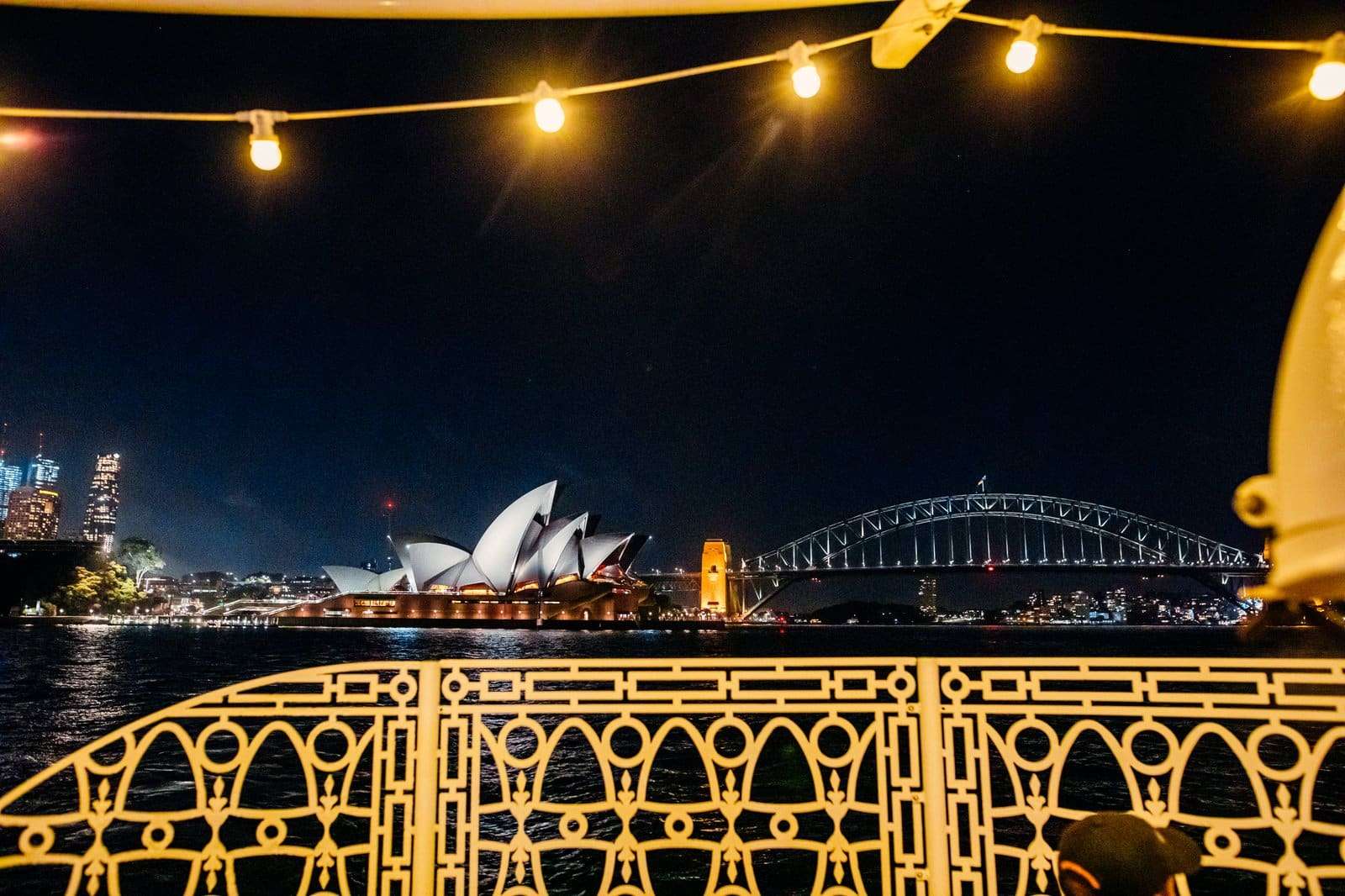
The classic run works west to east. From the water off Circular Quay you get the money shot: Opera House sails fully lit, with the Quay’s buildings glowing behind. Move under or past the Bridge for its lighting in full span — the view back at the Bridge with the city behind it is best from the west, around Blues Point and McMahons Point water. The east side of the Opera House, looking back toward the Bridge, stacks both icons in one frame — the postcard. Further out, Athol Bay and the water off Cremorne Point give you the whole skyline as a single glowing panorama with reflections running toward you across the harbour. A good Vivid charter does this as a slow loop, pausing at each angle; tell your skipper photography matters and they’ll build the route around it.
When during the evening should you shoot?
The most underrated window is the first 30–40 minutes after the lights come on, while there’s still deep blue in the sky — photographers call it blue hour, and it’s the difference between lights floating in black nothing and lights set against a rich twilight city. Vivid runs over winter (late May into June), so the lights start early in the evening — you don’t have to stay out late for full darkness. Build your cruise so you’re in position off the Opera House as the lights come up, shoot the blue-hour window hard, then enjoy the rest of the loop with the pressure off. Mid-evening, the water traffic settles and reflections improve; late evening gives you the same shots with fewer boat wakes through your foreground.
What should photographers bring aboard?
Less than you’d take to a land shoot. One camera, one fast lens (a 24–70mm f/2.8 or a fast 35mm covers nearly everything; a wide zoom earns its place for under-the-Bridge moments), spare battery (cold nights drain them faster), and a microfibre cloth for salt haze — you’ll use it every twenty minutes. Skip the tripod; it’s useless on deck and a trip hazard in the dark. A small dry bag protects gear from spray on the open sections. And dress warmer than you think: Vivid is a winter festival, it’s colder on the water than on shore, and cold hands end photo sessions early. Beanie, gloves you can shoot in, proper jacket.
How do you set up the charter itself for photography?
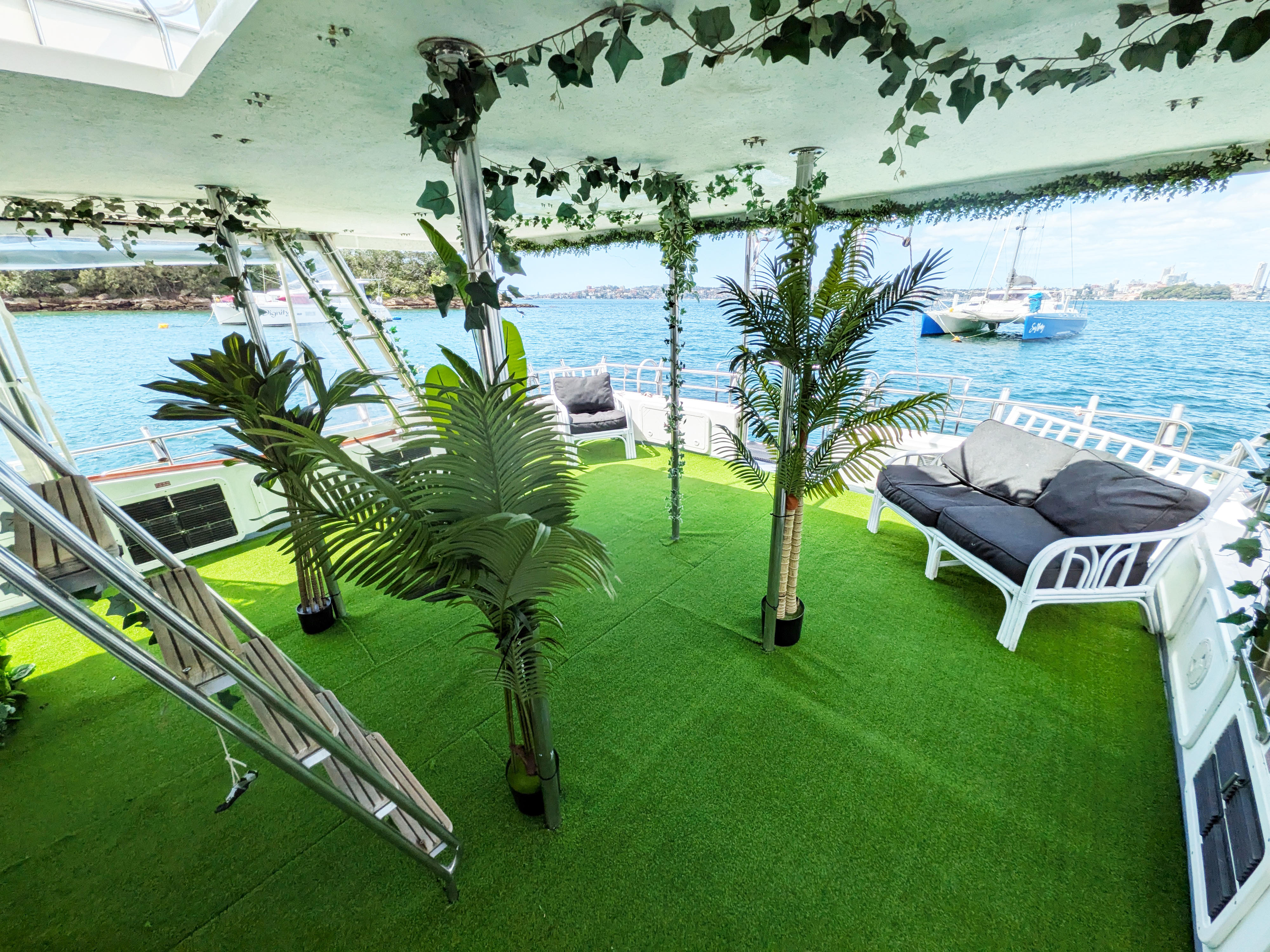
Group size and boat choice matter more than gear. A smaller vessel with open deck space beats a big enclosed cruiser for shooting — you want 360-degree access to the rails and the ability to talk to the skipper. Brief them at boarding: you want slow passes of the Opera House and Bridge, a couple of engines-off holds in flat water, and deck lights down for the key shots (interior lights reflecting off your lens ruin night photos). Winter is also the value season on the harbour — hire rates typically run 20–40% below summer — so a private Vivid photography charter costs less than most people assume; see what boat hire costs in Sydney for the working ranges, or get a quote for your group and date.
Frequently asked questions
Can you use a tripod on a Vivid cruise?
It’s not worth bringing — the boat moves, so a tripod just transmits that movement. Faster shutter speeds, higher ISO and bracing on the rail work far better.
What’s the best phone technique for Vivid from a boat?
Standard photo mode with exposure tapped down on the lights while moving; save night mode for engines-off holds. Clean the lens often and lean on stabilised video.
When does Vivid run and how cold is it on the water?
Vivid runs over late autumn into winter — late May into June. On the water it’s noticeably colder than on shore, so dress in proper winter layers.
Can the skipper stop the boat for photos?
On a private charter, yes — engines-off holds in flat water are the single best thing you can ask for as a photographer. Brief the skipper at boarding.
Is a Vivid charter expensive?
Less than most expect — Vivid falls in the winter value season, when hire rates typically sit 20–40% below summer. Smaller BYO boats start around $200–$400 per hour.